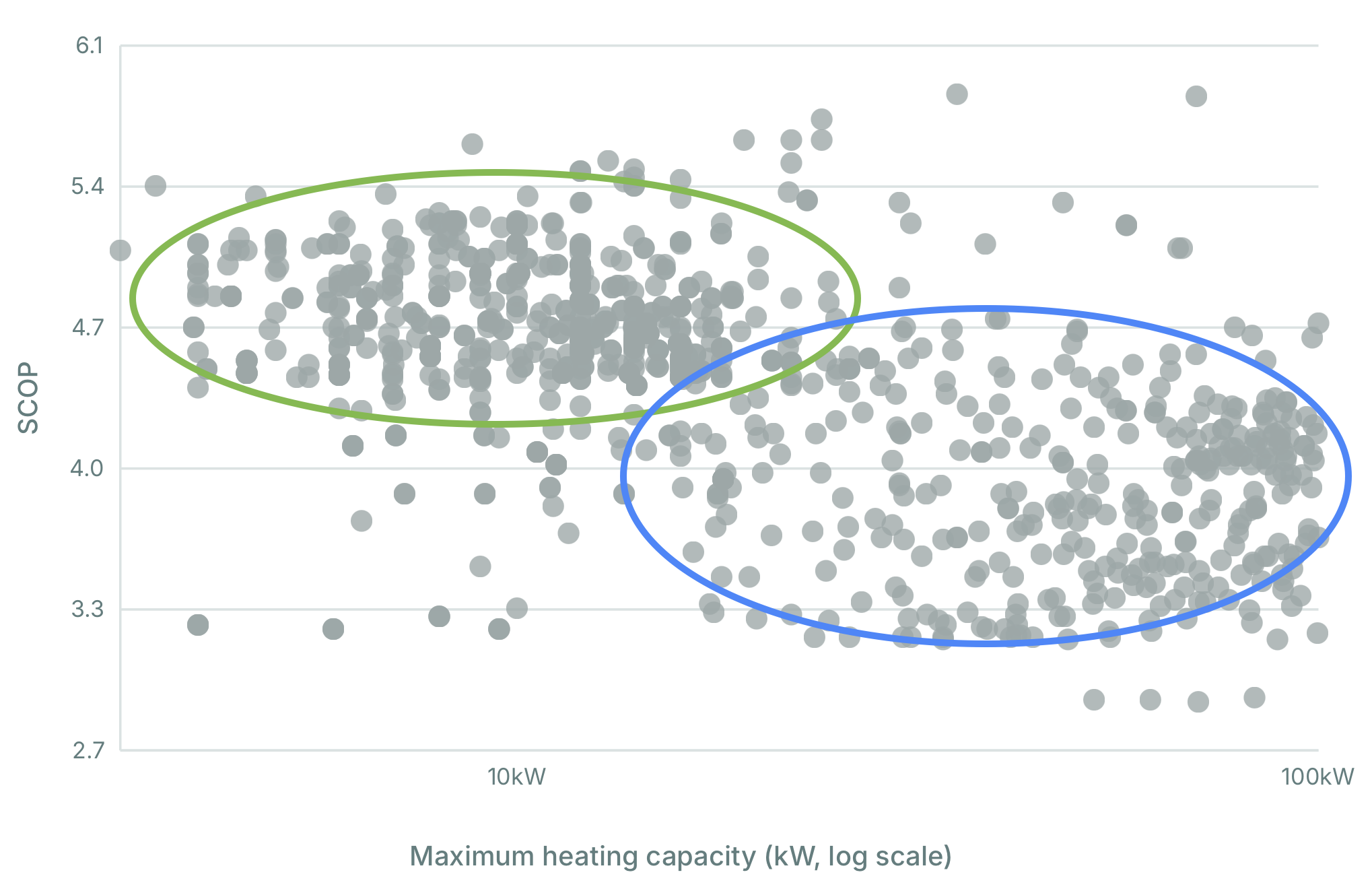
Anyone who spends time in the Visualise section of this database will have noticed the same thing: plot SCOP against maximum heating capacity, and there's a visible step down once you cross roughly 20kW. Products in the 4–20kW band, which covers most UK homes, cluster noticeably higher than the commercial-scale units above it. We dug into the underlying data to find out whether that's a real effect or an artefact of how the chart is drawn, and if real, why it happens.
The pattern holds up under scrutiny
The naive comparison (every product with a published SCOP, split at 20kW) shows a modest gap: 4.79 average SCOP for 4–20kW products versus 4.64 for those above 20kW. That's real but small, and it's diluted by mixing heat pump types: ground and water source units, which behave differently from air source, are unevenly distributed between the two bands.
Once we control for that, looking only at air source heat pumps tested at the same flow-temperature condition (SCOP at W35, the standard EN 14825 basis), the gap widens substantially: 4.68 average SCOP for 4–20kW ASHPs, versus 3.92 for those above 20kW. That's a 15–20% relative difference, and it holds within every major refrigerant type we checked:
| Refrigerant | 4-20kW mean SCOP | >20kW mean SCOP |
|---|---|---|
| R32 | 4.69 | 4.03 |
| R290 | 4.87 | 4.16 |
| R410A | 4.21 | 3.69 |
So it isn't simply that small heat pumps happen to use a more efficient refrigerant blend. Something else is going on.
It's really a residential-vs-commercial split
The clearest signal in the data is who's making these products. In the 4–20kW band, 94% of listings are residential units, dominated by brands like Daikin, Panasonic, LG, Riello and Baxi. Above 20kW, 98% are commercial units, dominated by HVAC specialists like Rhoss, Swegon, Clivet, Carrier and Trane. These are almost entirely disjoint markets, and that matters more than the capacity number itself.
Modulation, not just marketing
Most small residential ASHPs use a single variable-speed inverter compressor that can turn down to a small fraction of its rated output. SCOP is a seasonal average dominated by part-load conditions, mild autumn and spring days rather than the coldest day of the year, so a compressor that modulates smoothly down low is exactly what the metric rewards.
Larger commercial systems more often reach their capacity by staging multiple compressors on and off rather than continuously modulating one, which is a sensible way to guarantee output for a building but tends to be less efficient at partial load, precisely the condition SCOP weights most heavily.
Two explanations we ruled out
Before settling on the above, we checked two obvious alternatives:
Are the big units just working harder, with higher flow temperatures? No. If anything, the 4–20kW band has a slightly higher average maximum flow temperature (67°C vs 60°C), which should hurt their SCOP relative to the larger units, not help it.
Is this just a reporting gap: do fewer large commercial products even publish SCOP? Partly, but not enough to explain it. 73% of 4–20kW products in the database list an SCOP figure, versus 63% of those above 20kW: a real gap consistent with SCOP being a residential/policy-driven metric, but far too small on its own to account for a 0.7-point difference in the average.
The takeaway
If you're comparing a domestic-scale heat pump against something plumbed for a larger building, don't expect the SCOP figures to be comparable on the same terms: they're drawn from different markets with different design priorities and different regulatory pressure. For sizing a home, the 4–20kW figures in this database remain the fair like-for-like comparison; for commercial specification, capacity, reliability and total installed cost typically matter more than chasing the last point of seasonal efficiency.
Sources & further reading
The mechanisms behind this gap (part-load behaviour, compressor modulation and the different regulatory pressure on residential versus commercial equipment) are corroborated by independent industry and technical sources:
- Lochinvar – “SCOP vs COP: What Engineers, Specifiers, and M&E Contractors Need to Know for Commercial Decarbonisation Projects”, on why SCOP carries different weight and regulatory drivers in commercial specification than in the residential market.
- IDM Energie – “Part-Load Operation in Heat Pumps”, explaining why modulating systems achieve higher seasonal efficiency because COP improves at part load, and buildings spend most of their time there.
- IDM Energie – “EN 14825 Standard: Heat Pump Seasonal Performance Testing”, on how the standard this database’s SCOP figures are drawn from explicitly weights part-load performance rather than a single full-load point.
- HVAC Know It All – “Variable Speed Scroll Compressors: Why They Dominate Modern Heat Pumps”, on why continuously modulating compressors outperform staged/cycling designs at part load, the operating pattern more common in larger commercial units.