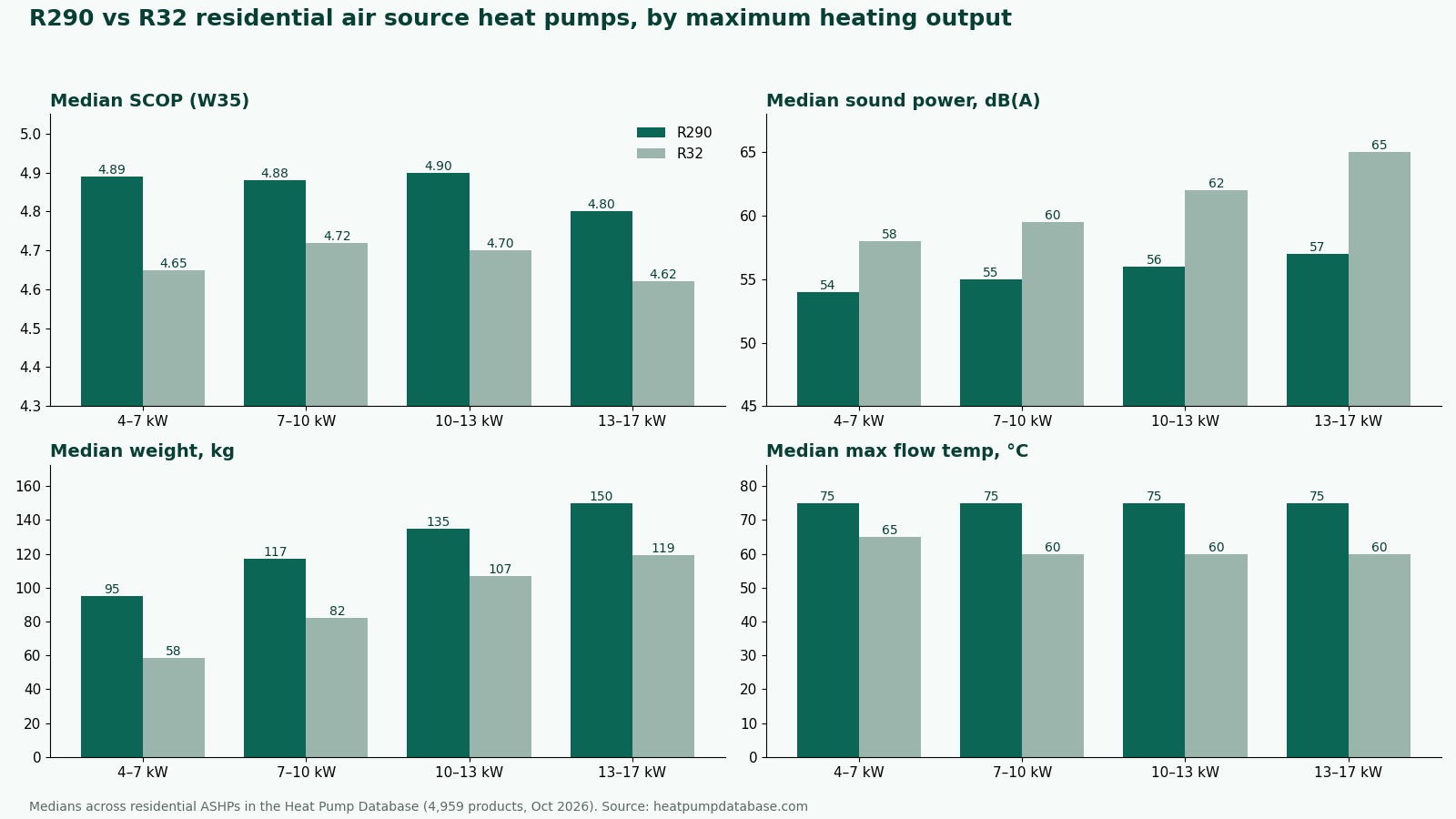
Natural refrigerant R290 (propane) has gone from niche to mainstream in a few short years. Across the residential air source heat pumps in this database, there are now 675 R290 models from 74 manufacturers, compared with 951 R32 models from 62 manufacturers. More brands now offer an R290 home heat pump than an R32 one.
The usual pitch for R290 is “better for the planet and more efficient”. We wanted to see what the specification sheets actually say – and what you give up. To keep the comparison fair, we split every residential ASHP into four bands by maximum heating output and compared the median R290 unit against the median R32 unit in each band.
1. Efficiency: a small but consistent R290 advantage
In every size band, the median R290 heat pump has a higher SCOP at 35 °C flow: 4.80–4.90 against 4.62–4.72 for R32. That is a gap of roughly 0.15–0.25, or about 3–5%. It is real and it shows up at every size, but it is smaller than the marketing sometimes suggests. In running-cost terms, a 4% SCOP improvement trims around 4% off the electricity used for space heating.
2. Flow temperature: the biggest practical difference
This is where the two refrigerants really split. The median R290 unit in every band reaches 75 °C, and 74% of residential R290 models in the database are rated to at least 75 °C. Not one residential R32 model reaches 75 °C; their median maximum is 60–65 °C.
For homeowners, that matters most in older houses. A 75 °C flow means an R290 heat pump can often run existing radiators and heat hot water to legionella-safe temperatures without an immersion heater. Running that hot does cost efficiency, though – see our flow temperature guide for why lower is still better when you can manage it.
3. Noise: R290 units are quieter on paper
Median sound power is 4–8 dB(A) lower for R290 in every band, and the gap widens with size: 54 vs 58 dB(A) at 4–7 kW, rising to 57 vs 65 dB(A) at 13–17 kW. Because decibels are logarithmic, a 6 dB difference means roughly a quarter of the sound energy.
Some of this is down to design rather than chemistry. Many R290 units are newer, with larger, slower fans and bigger casings, and manufacturers don’t all measure sound power under the same conditions. Even so, it matters in the UK, where permitted development depends on meeting 37 dB(A) at the nearest neighbour’s window. You can check a specific model with our MCS 020 noise calculator.
4. Weight: the trade-off nobody mentions
R290 units are consistently heavier. The median 4–7 kW R290 unit weighs 95 kg against 58 kg for R32 – about 60% more. The gap narrows in percentage terms as units get bigger, but the R290 model is still around 28–37 kg heavier at every size. Larger heat exchangers and casings, which help efficiency and noise, add the weight. Installers should plan for a two-person lift, and wall brackets are rarely an option.
5. Price: a premium at the small end
Where we have UK retailer prices for the unit alone, R290 carries a premium in the smaller sizes: a median of about £550 per kW against £475 for R32 at 4–7 kW, and £420 against £365 at 7–10 kW. At 10–13 kW the two are level (about £350 per kW). These figures come from a smaller sample – 30–57 priced models per group – so treat them as a guide, not a quote.
How we did it
We took every residential air source heat pump in the database using R290 or R32 and grouped them by maximum heating output (4–7, 7–10, 10–13 and 13–17 kW). We used medians so a few extreme models can’t skew the result. SCOP uses only values declared at 35 °C flow; noise uses only declared sound power (not sound pressure). Each band contains between 77 and 167 models with a published SCOP. Prices are unit-only UK retailer prices, excluding installation. Data correct at 31 October 2026.
Explore the models yourself: all R290 heat pumps, all R32 heat pumps, the best R290 heat pumps, or our refrigerant guide.